
Australia and New Zealand
Australian and New Zealand clients are taxed on their investments in ways a generic portfolio tool does not handle: franking credits on Australian dividends, superannuation funds held in investment options rather than shares, and New Zealand's foreign investment fund (FIF) rules. This page explains what Borderfolio calculates for each, where the inputs come from, and what is left to your judgement.
Australian franking credits
An Australian company that has paid tax attaches franking credits to its dividends. For an Australian tax resident the credit is added to taxable income and then offset in full; any excess is refunded. Borderfolio does not invent the franked share: no free source publishes it reliably, so you enter it per holding from the company's dividend notice (ASX Appendix 3A.1) or the fund's annual tax (AMMA) statement.
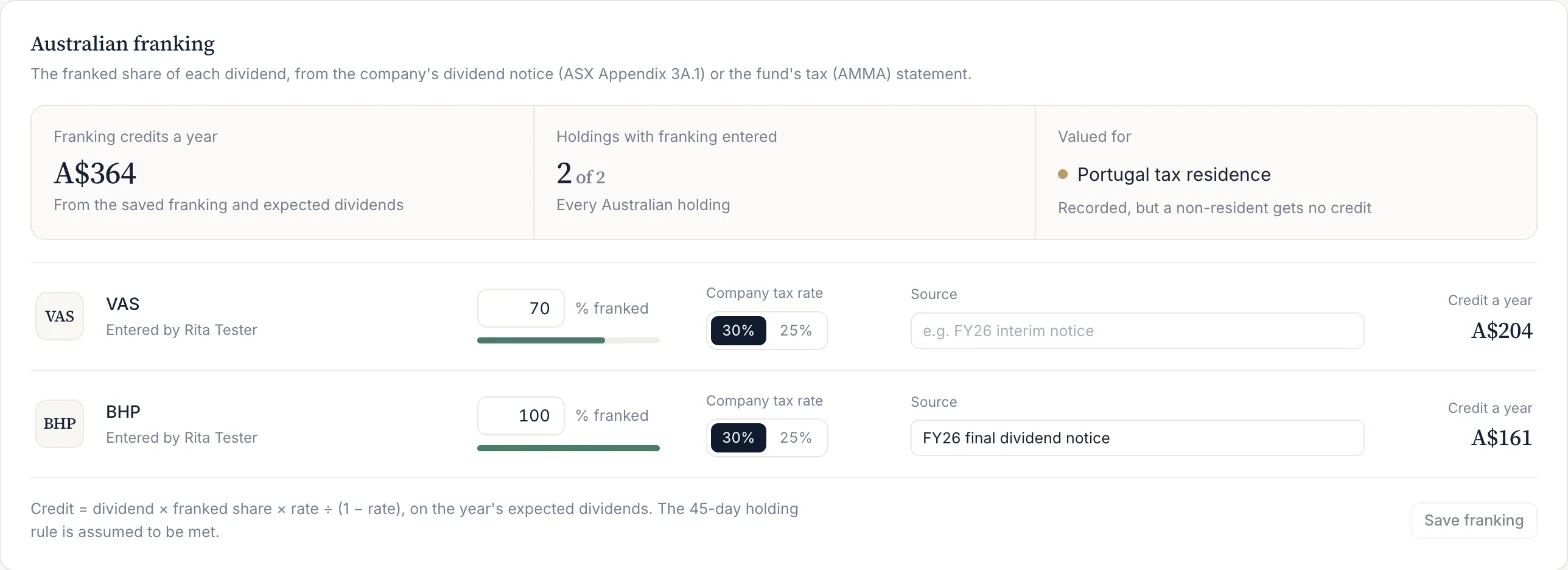
- The credit is dividend × franked share × rate ÷ (1 − rate), where the rate is the paying company's: 30%, or 25% for a base rate entity.
- Australian resident, taxable account: the grossed-up dividend is taxed at the client's rate and the credit offsets it; an excess is refundable.
- Super in accumulation phase (the super wrapper): taxed at 15%, so a fully franked dividend usually leaves an excess credit, shown as a refund to the fund.
- Super in retirement phase: earnings are exempt, so the whole credit is refunded.
- Not an Australian resident: the credit is recorded but has no value; franked dividends are not subject to Australian withholding.
The credit appears in the scenario's tax basis card and in dividends kept after tax. For an Australian resident the report adds a franking credits finding listing each holding. Holdings left at 0% are treated as unfranked, and the card says how many are entered. The 45-day holding period rule is assumed to be met. For the rules behind it, with a worked example for individuals and super funds, see franking credits for SMSF clients.
Sources: ato.gov.au, refunding excess franking credits
Superannuation
There are three ways to bring a client's super into Borderfolio, depending on how it is held:
- A self-managed fund (SMSF) or a wrap platform with listed holdings: import the statement or enter the holdings, and set the account's tax wrapper to Super / SMSF, accumulation phase or retirement phase. Dividends, gains, US withholding and franking are then calculated at the fund's rates.
- A mixed fund with members in both phases: create a firm wrapper with a blended rate, for example 60% retirement phase.
- A retail or industry fund held in an investment option (for example a Balanced option): add it under Other assets as a Super fund option.
Super fund options
Enter the fund, the investment option, the phase, and either the number of units with the unit price or the balance from the member statement, with its date. Add the fees from the fund's product disclosure statement: the investment fee and the administration fee (as a percentage, a fixed dollar amount, or both).
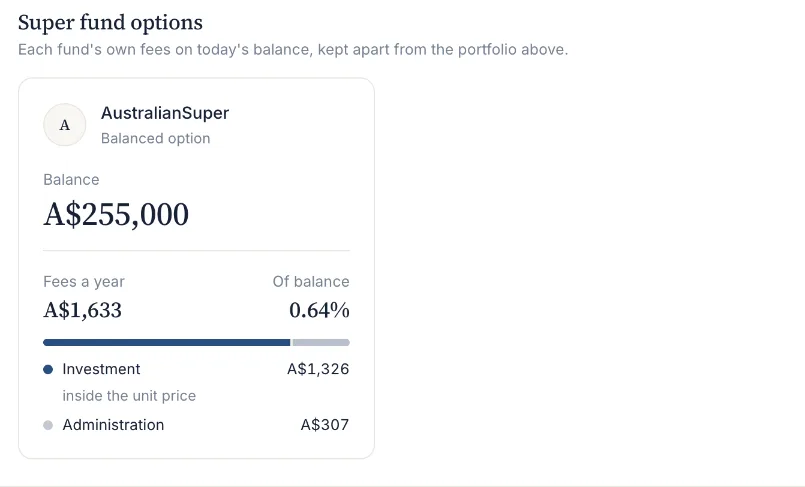
A unit price is already net of the fund's tax and investment fees, so Borderfolio deducts neither again. No franking or residence tax is applied to the option. The balance counts towards the client's total wealth. The investment fee is shown for transparency, and the administration fee is a real deduction from the member's account.
New Zealand: the FIF rules
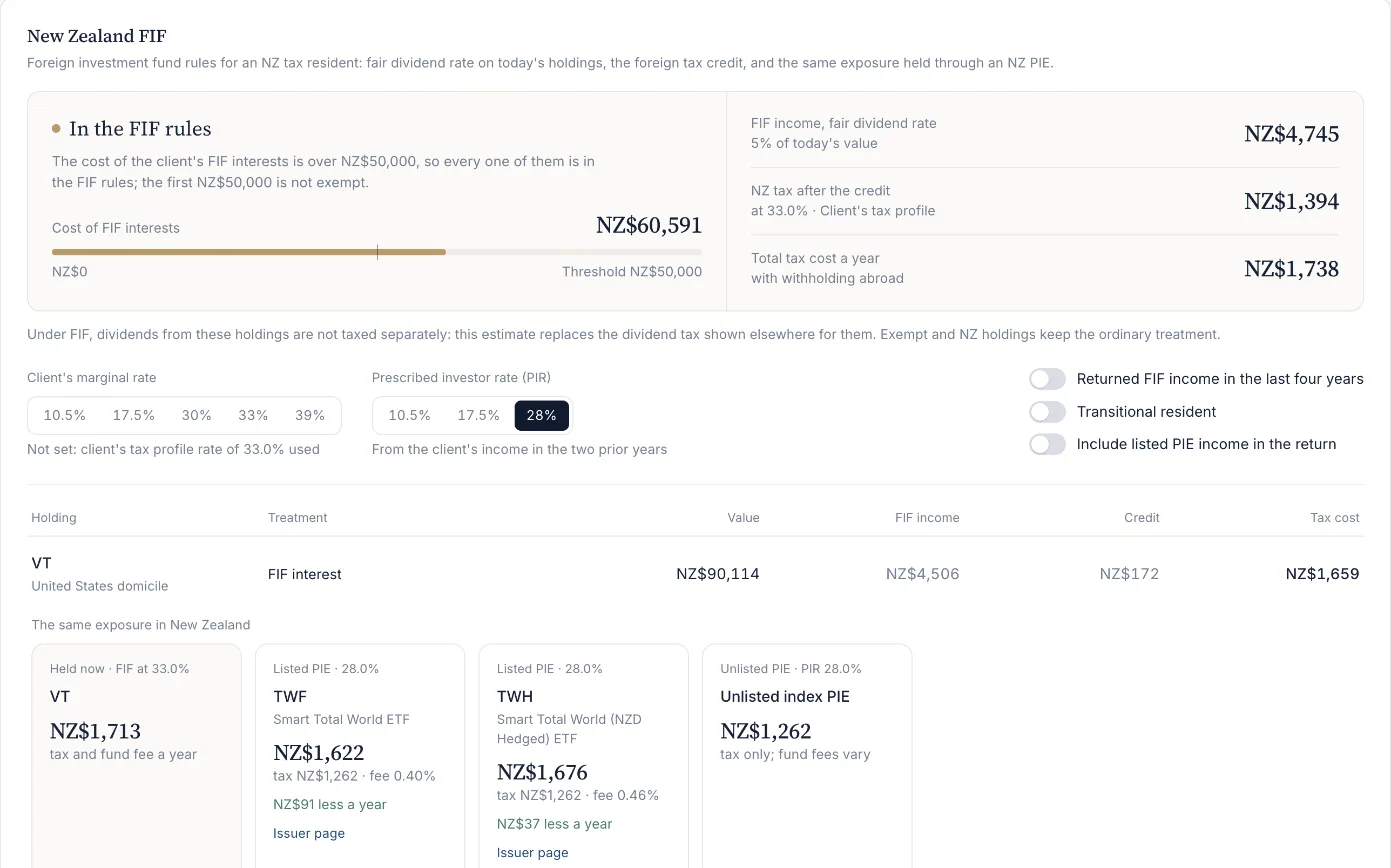
A New Zealand tax resident holding offshore shares or funds (US ETFs, Irish UCITS funds, most Australian ETFs) may fall under the foreign investment fund rules. If so, dividends and gains on those holdings are not taxed separately. Instead, the client is taxed on deemed income each year. Borderfolio estimates this from today's holdings for the client's residence, or for a planned or what-if move to New Zealand in a scenario.
- Which holdings count. NZ companies and NZ funds (PIEs) are not FIF interests. ASX-listed Australian companies that keep a franking account are exempt (s EX 31). An Australian unit trust, which includes most ASX ETFs, is exempt only if it meets s EX 32. Confirm that with the issuer, then mark the holding Meets s EX 32. Everything else is a FIF interest.
- The NZ$50,000 threshold. The test is on the total cost of FIF interests at any time in the year, not their value. Above it, every interest is in the rules, including the first NZ$50,000. Below it, dividends are taxed in the ordinary way, unless the client returned FIF income in any of the last four years; set that switch if so. Transitional residents are outside the rules.
- Fair dividend rate. The FIF income is 5% of the opening value, taxed at the client's marginal rate. Pick the rate, or Borderfolio uses the one from the client's tax profile, or 33% labelled as assumed.
- Foreign tax credit. US withholding on a US-domiciled fund is credited up to the 15% treaty rate and the NZ tax on that holding. Tax withheld above 15%, for example 30% without a W-8BEN, is a cost. Withholding suffered inside an Irish fund belongs to the fund and gives no credit.
Comparing with an NZ PIE
For S&P 500 and total-world funds, Borderfolio shows the same exposure through New Zealand portfolio investment entities (PIEs):
- Listed PIEs such as Smart US 500 (USF), Smart Total World (TWF) and their NZD-hedged versions. They pay tax at 28%, and their distributions are excluded income for the client. A client on a lower rate can include them in the return to recover the difference; set Include listed PIE income in the return to use the lower rate.
- An unlisted multi-rate PIE, taxed at the client's prescribed investor rate (PIR: 10.5%, 17.5% or 28%). This shows tax only, because unlisted funds' fees vary.
Each comparison adds the fund fee to the tax. Fund fees are taken from the issuer's page, which is linked from each card. The result is shown as a cost a year, more or less than holding the fund now. It is a comparison, not a recommendation. Switching funds has its own costs and timing, and in the year of a sale the quick sale adjustment can apply.
The report includes a New Zealand FIF finding with the holdings table and the PIE comparison. For the rules behind it, with a worked example, see New Zealand FIF tax for advisers.
Sources: IRD, Guide to foreign investment funds (IR461, April 2026), IRD fact sheet IS 24/10 FS 1, Income Tax Act 2007, Part E, IRD tax rates for individuals, Smart ETFs
What is not modelled
- Australia: Division 296 (the additional tax on super balances above $3 million), tax on super withdrawals and death benefits, the transfer balance cap, live unit prices for retail and industry funds, and franking data feeds.
- New Zealand: the comparative value method, which an individual may choose in a year when it gives less (floored at zero). It needs the whole year's flows. Also not modelled: the quick sale adjustment, the exchange-rate election (today's rate is used), credits for withholding by countries other than the US, KiwiSaver balances (add them under Other assets), and the revenue account method for new residents.
Every figure is an estimate for professional review, with its inputs and sources shown, not tax advice.
Last updated . Describes the product as built; figures are screening estimates, not tax, legal or investment advice.