For advisers to US persons abroad

PFICs, FBAR,two cost bases:one sourced review,under your name.

For a US prospect’s second opinion, a fixed-fee review of an expat’s DIY portfolio, or every client’s annual check: import the statements, see which funds are likely PFICs, whether FBAR and Form 8938 are due, each gain in dollars and in the local currency, and which accounts the US does not treat as tax-free, then deliver a client-ready report in your firm’s name.

For advisers to US citizens and green-card holders in the UK, Canada, Europe and Australia, advice-only planners reviewing expats’ DIY portfolios, and boutique wealth firms.

The sample is a read-only UK demo firm whose clients include a US citizen in London: fictional clients, real prices. Ready for your own? Start a 30-day free trial, no card needed.

Illustrative: one client review — the statements, the cross-border brief, a finding and the report cover — drawn from the product's own components. Figures are examples, not client data. Reports are rendered from a stored snapshot and never change after later imports.

A real example

What one review found.

The global ETF in this client’s ISA is what a British neighbour would hold. For a US citizen it is likely a PFIC, the ISA does not shelter it from US tax, and the Irish FTSE 100 fund in the general account shows a gain in pounds and a loss in dollars.

Why: a fund domiciled outside the US generally meets the PFIC income or asset test, so two of the three holdings, 59% of the portfolio, are listed with the Form 8621 filings they are likely to bring. The UK treats the ISA as tax-free; the US does not, and the review says so in its own finding. In the general account each holding’s cost is replayed from the confirmed trades twice, by the UK’s Section 104 pool in pounds and first in, first out in dollars, every purchase at its own date’s rate: ISF, bought while the pound was stronger, shows a gain of GBP 7,260 and a loss of USD 3,563.

Decision support for professional review, not tax advice. No PFIC tax is computed and no Form 8621 is prepared: elections, the excess-distribution charge and the filing exceptions are for the client’s US tax adviser. A holding whose cost is not known stops the total; it is never guessed.

In the workspace
Possible PFIC holdingsINDICATIVE · ATTENTION

2 holdings, 59% of the portfolio, are funds domiciled outside the US and likely PFICs for this US person; each is generally reported on Form 8621 every year. VWRL in the ISA and ISF in the Interactive Brokers account, both Irish.

Assumes
A fund domiciled outside the US generally meets the PFIC income or asset test; domicile from the ISIN; directly held shares not screened
Source
Holdings on file; IRC §1297; IRS Form 8621 instructions
In the client’s review
7Cross-border considerations
Possible PFIC holdings

2 holdings, 59% of the portfolio, are funds domiciled outside the US and likely PFICs for this US person: VWRL in the Hargreaves Lansdown ISA (GBP 268,400) and ISF in the Interactive Brokers account (GBP 172,500), both domiciled in Ireland. Each is generally reported on Form 8621 every year.

A screen, not a determination: the income and asset tests are the fund’s, and directly held shares are not screened. No PFIC tax is computed; QEF and mark-to-market elections, the excess-distribution charge and the filing exceptions are for the client’s US tax adviser. Source: IRC §1297; IRS Form 8621 instructions.
8Adviser notes

Your commentary, printed in its own section and never mixed with Borderfolio’s analysis.

Illustrative: the same finding as it appears in the workspace and in a generated review. Figures are examples, not client data.

Import. Find issues. Deliver. Keep reviewing.

Every step stays under your control. Nothing reaches a client’s holdings until you have reviewed and confirmed it.

  1. 01

    Import the statements.

    Upload the client’s statements from any broker, check what was extracted, and consolidate every account in their currency.

    Review importIBKR · 2026 Q3
    PositionSharesStatus
    VT · XNAS323New
    SMMCHA · XSWX7New
    VWRA · XLON410Unchanged
    Transactions found80 duplicates
  2. 02

    Find the issues.

    Costs, income, currency, fund domicile, withholding and residence matters, each with its source, its assumptions and what it does not cover.

    Consolidated view2 accounts · USD
    By trading currencyUSD 94.9% · CHF 5.1%
    Time-weighted return+16.6%annualised, since inception
    Money-weighted return+16.7%XIRR
    Expected annual income699.78 USDfrom trailing distributions
  3. 03

    Deliver the review.

    A client-ready PDF under your firm’s name, your commentary set apart from the analysis, frozen as generated.

    Portfolio reviewgenerated today
    Sections9summary to limitations
    Adviser commentaryIncludedlabelled as yours
    SnapshotFrozenreproducible on every download
    BrandingFirm namelogo and contact on Practice
04

Keep reviewing.

The accounts stay in the workspace. Import the next statements and the checks run again; last year’s report stays as sent.

  • The firm’s deskEvery client screened at once, most urgent first.
  • Reviews dueEach client’s review cycle, with offered, held and declined reviews recorded.
  • Reclaim deadlinesWithholding above the treaty rate, with the last day to claim it, across every client.
  • Before a moveThe same holdings at the new residence’s rates, and what leaving triggers.

The workspace

Built around the way advisers work.

Clients, imports, consolidated value, cross-border findings and reports, in one workspace your whole firm can use.

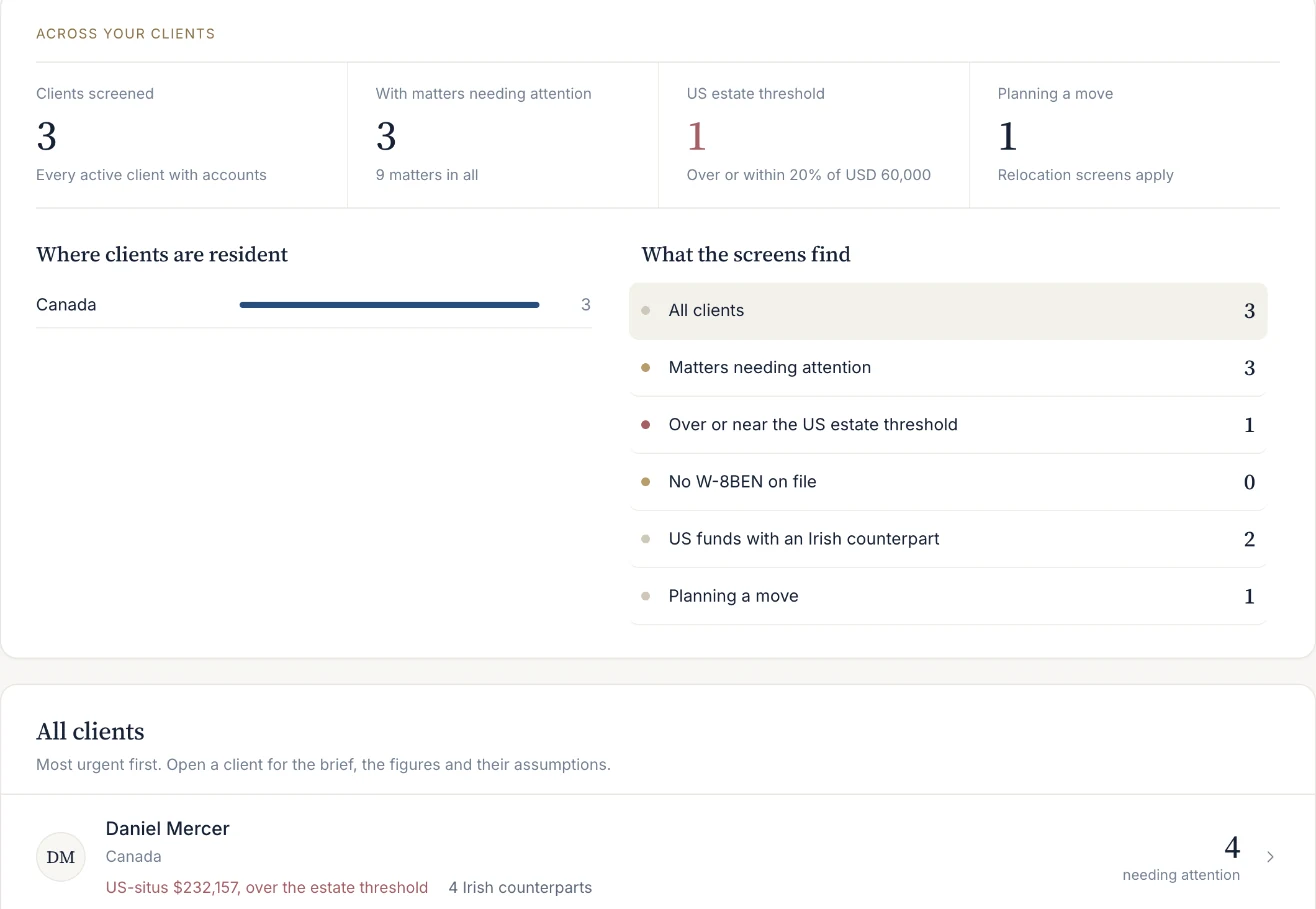
The firm’s desk

Who needs me this week?

Every client screened at once: who has matters needing attention, who is over the US estate threshold, who is planning a move. Then the clients, most urgent first.

The client dossier

What is the client actually worth?

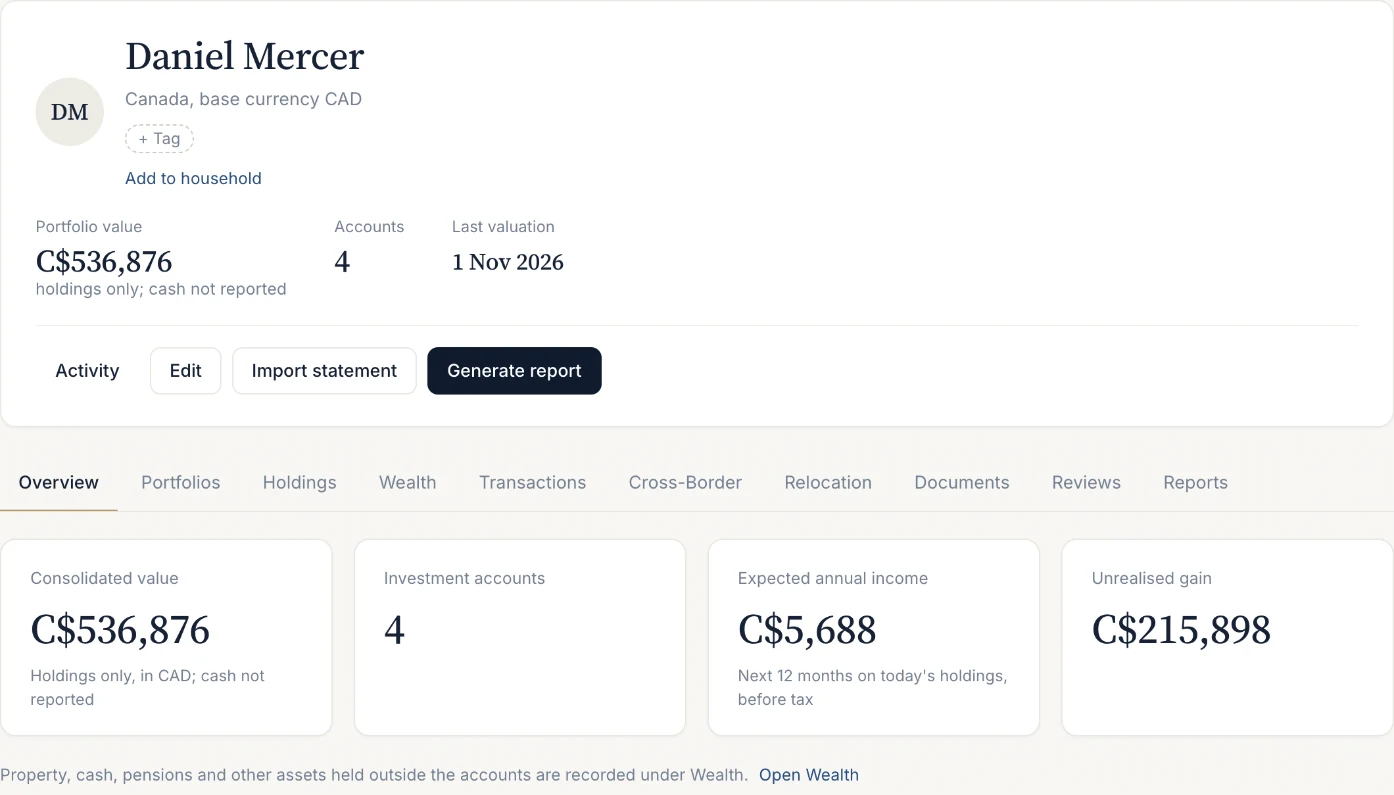
Four accounts valued in the client’s base currency, with the income expected over the next twelve months and the gain not yet realised. Cash that isn’t reported is said, not assumed.

Currency, looked through

Which currency is the money really in?

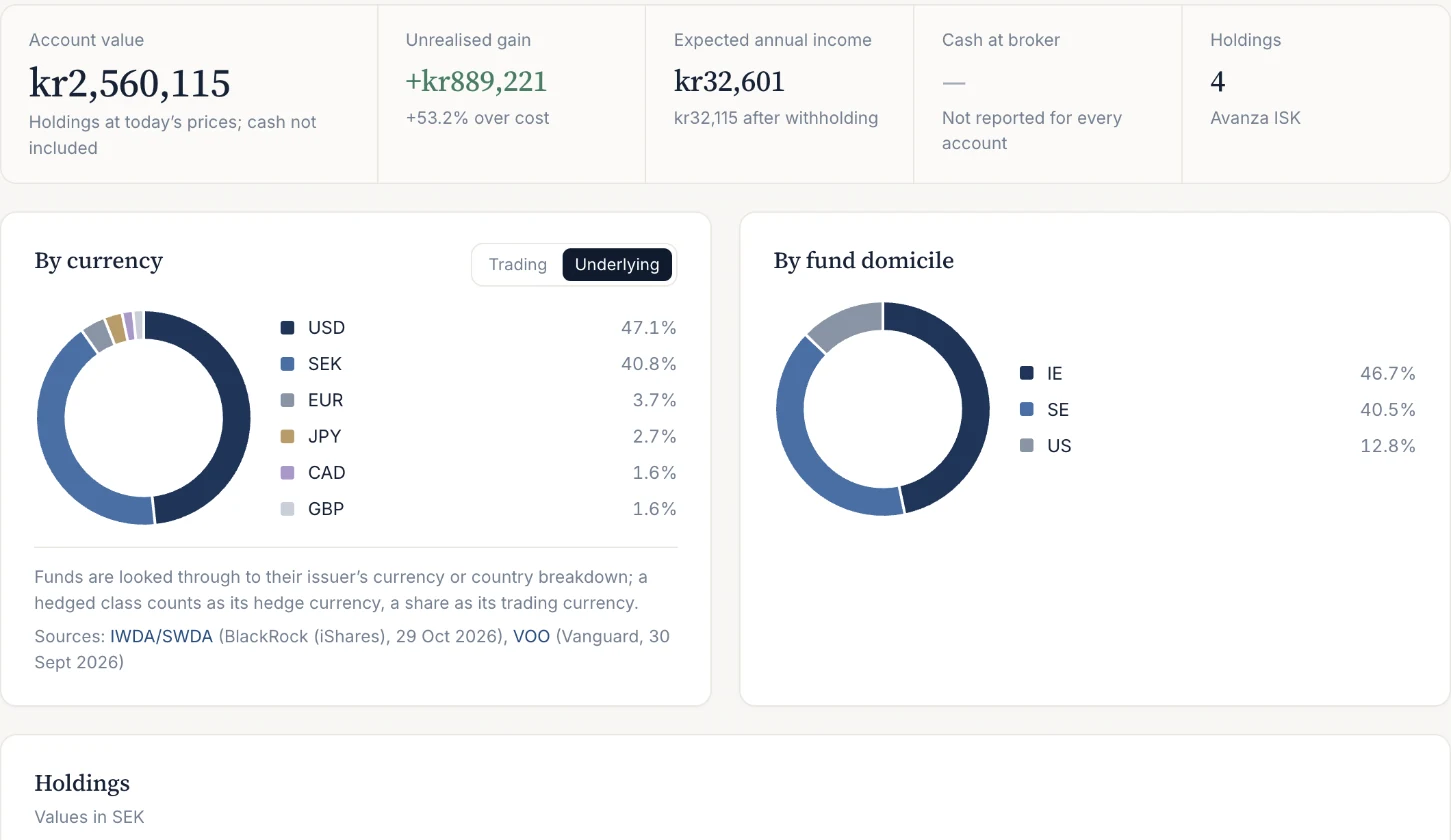
A Swedish client’s account, valued in kronor. Looking through the funds to their issuer’s breakdown, each source named and dated, 47.1% is in US dollars and only 40.8% in kronor.

Performance

How has it really done?

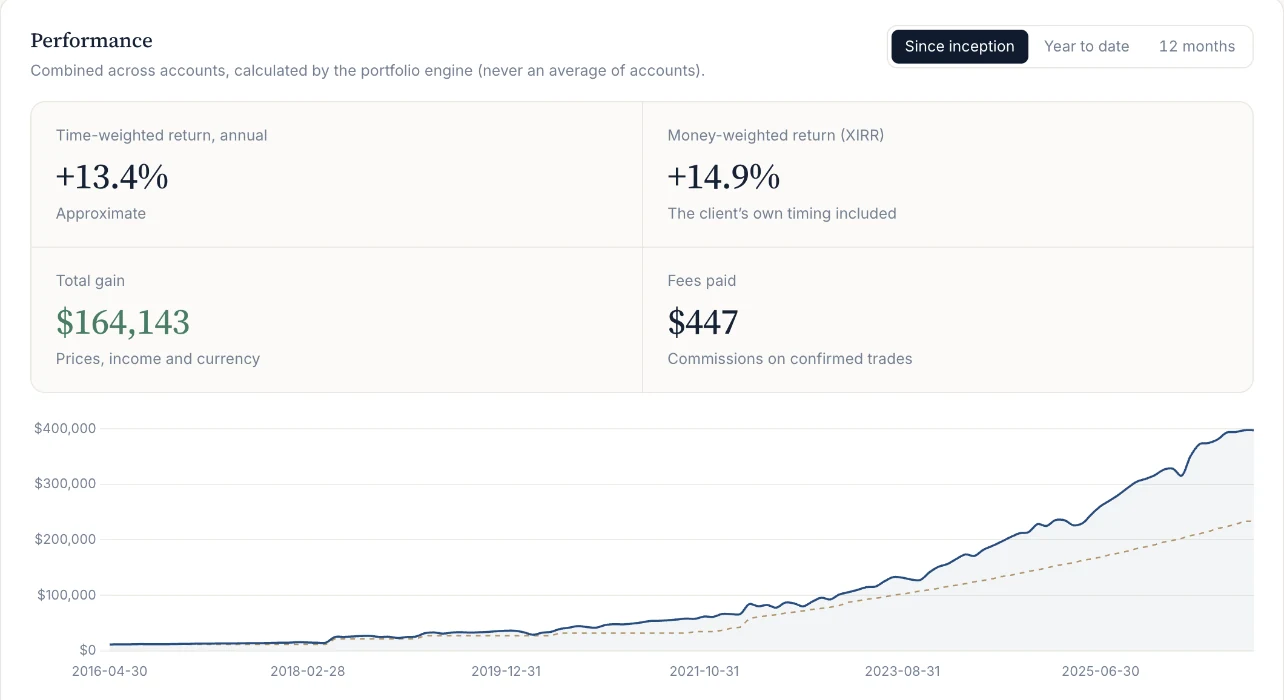
Time- and money-weighted returns combined across accounts, never an average of them, against a US-listed ETF benchmark with the withholding drag stated.

Cross-border brief

What could cost my client money?

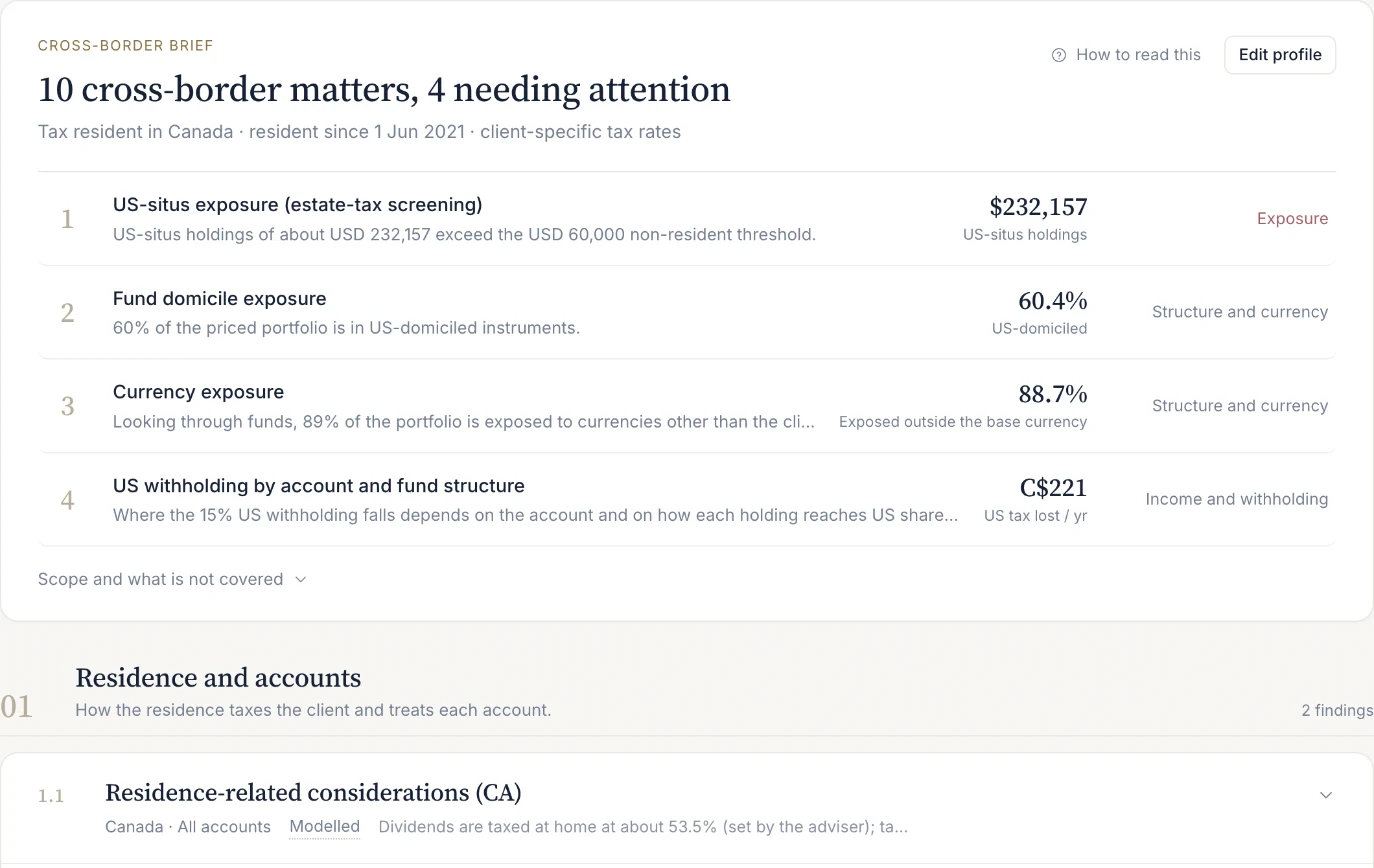
Ten matters for a Canadian resident, the four that need attention first: US-situs holdings over the USD 60,000 estate threshold, 60% in US-domiciled funds, 89% outside the base currency and C$221 a year of US tax lost by account.

European withholding

What can be claimed back?

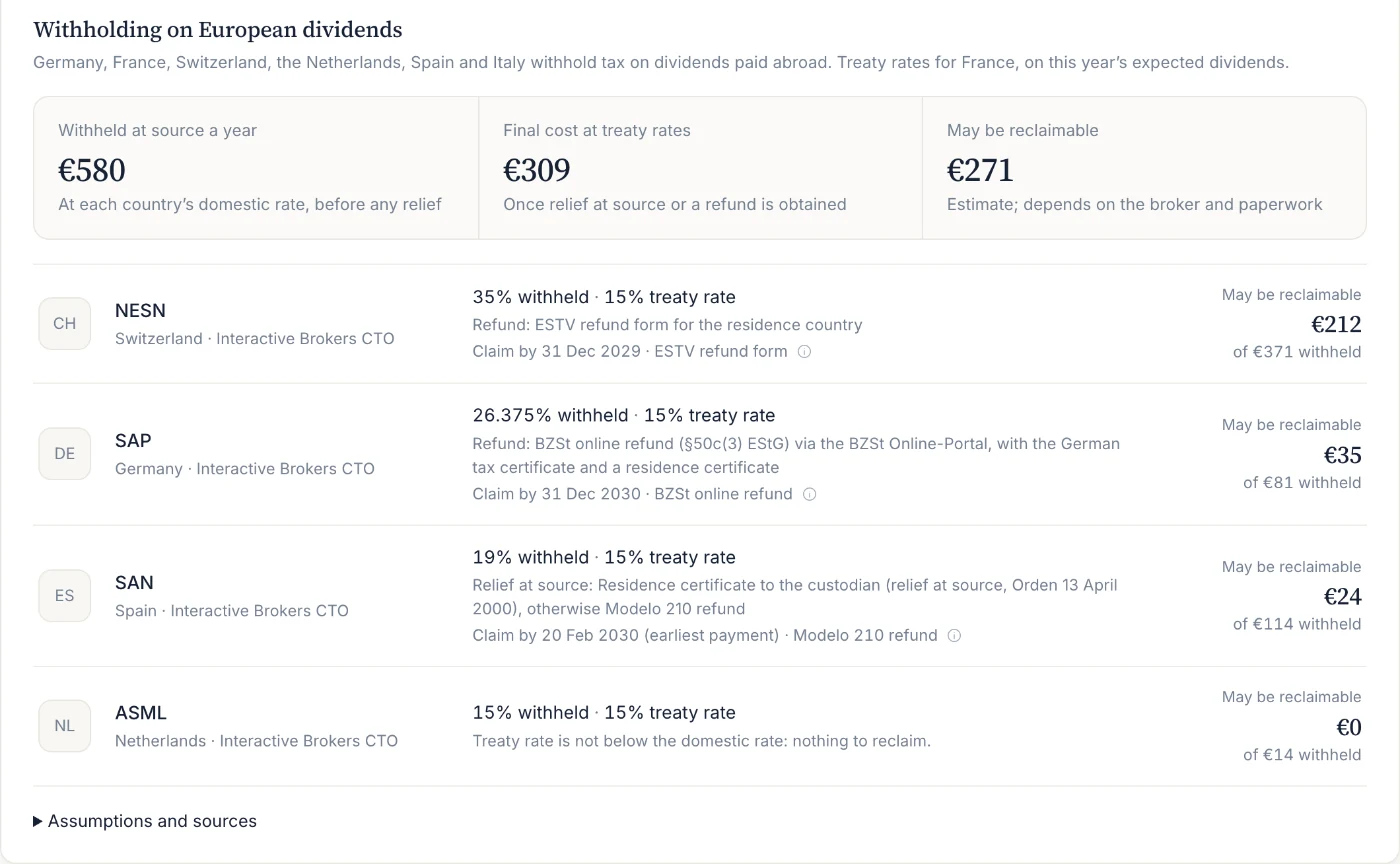
Each holding’s withholding at the source country’s rate against the treaty rate, with the route and the last day to claim. Here €271 a year may be reclaimable.

Scenarios

Should we switch this fund?

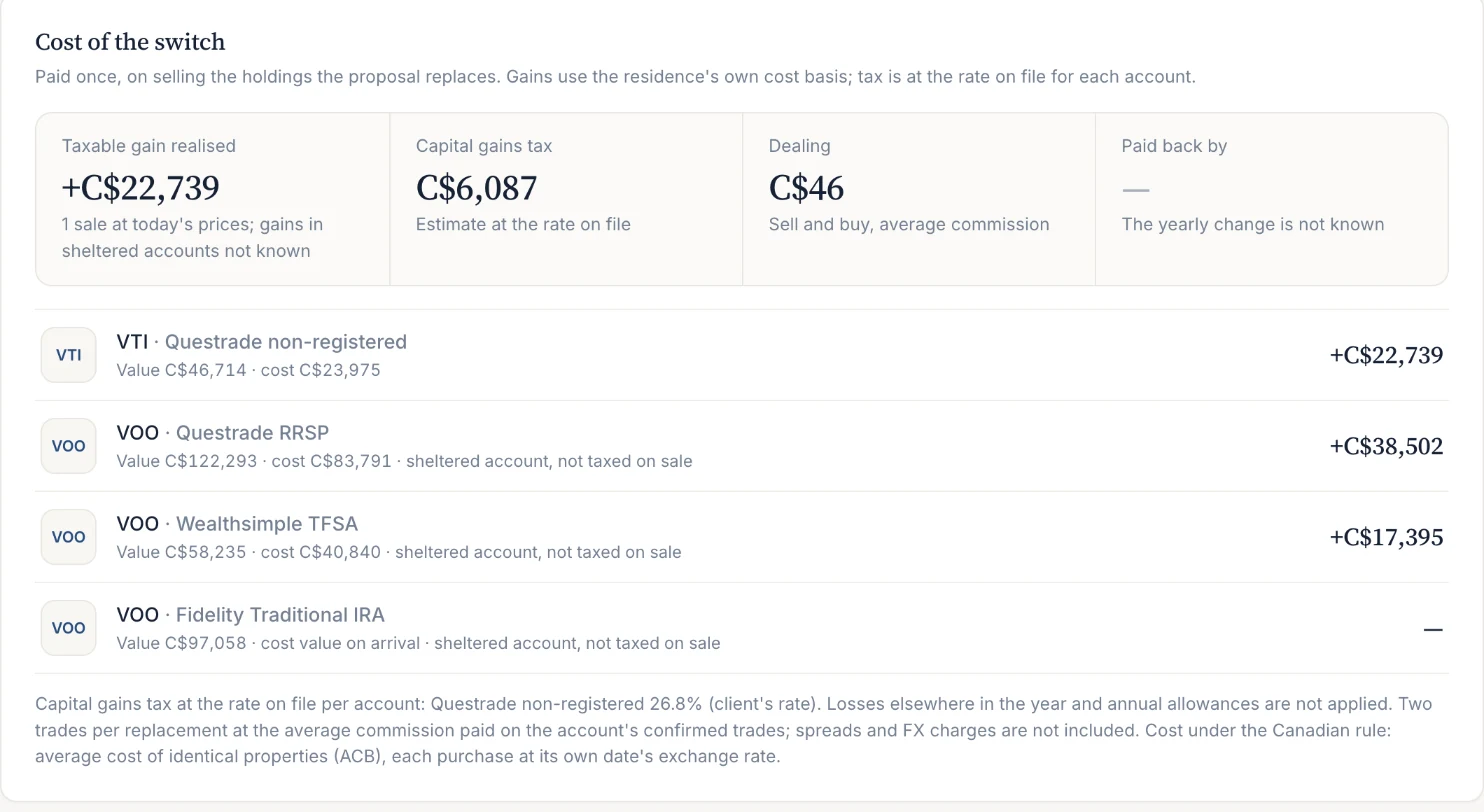
Replacing US funds with Irish ones starts with the bill: C$6,087 of tax on the one taxable sale and C$46 of dealing. The RRSP, TFSA and IRA sell without tax, and each is shown apart.

Planned move

What changes if they move?

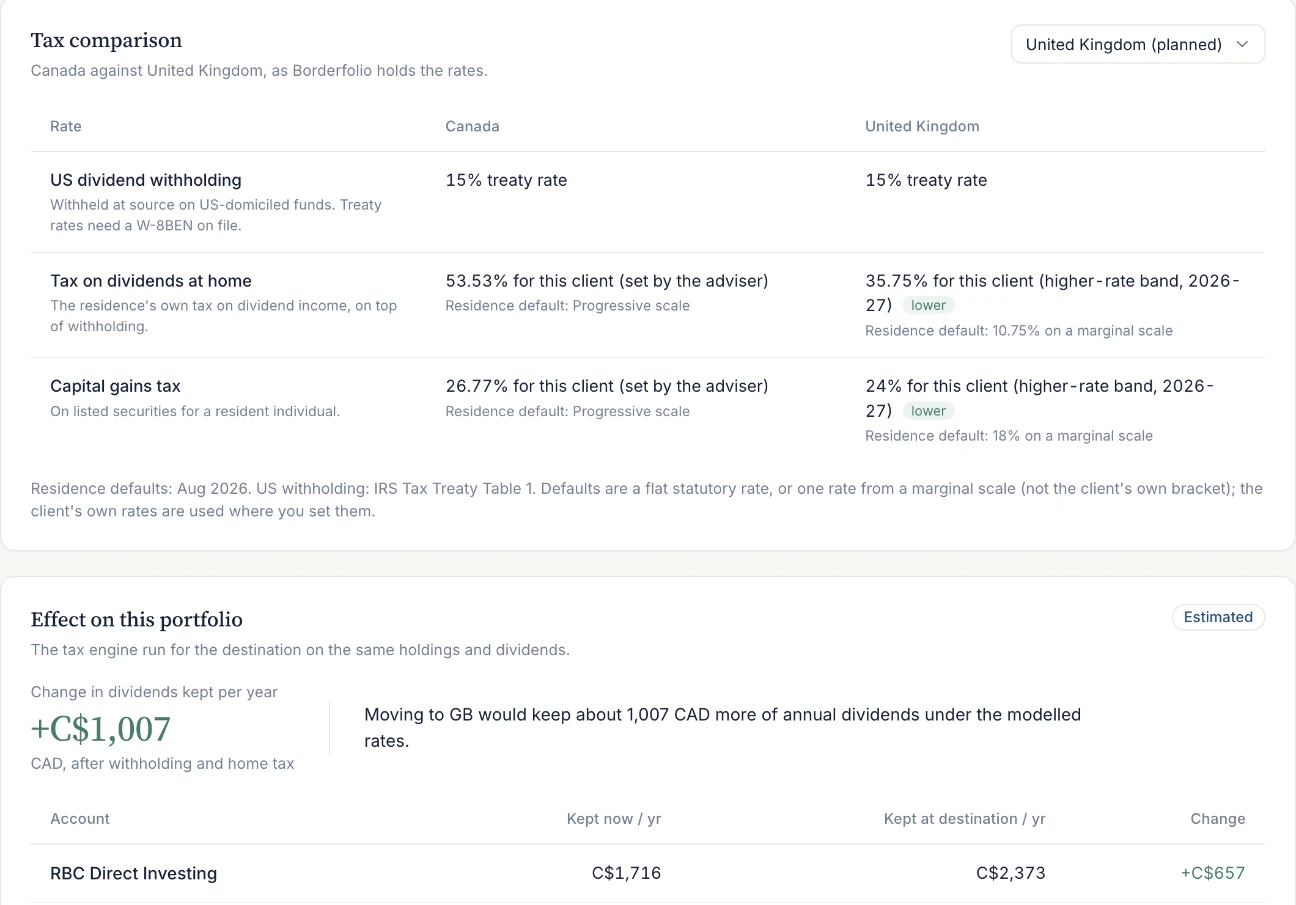
Canada at the client’s 53.53% against the UK higher rate of 35.75%, both set by the adviser: the same holdings keep about C$1,007 more in dividends a year.

Due across the firm

What is due before year end?

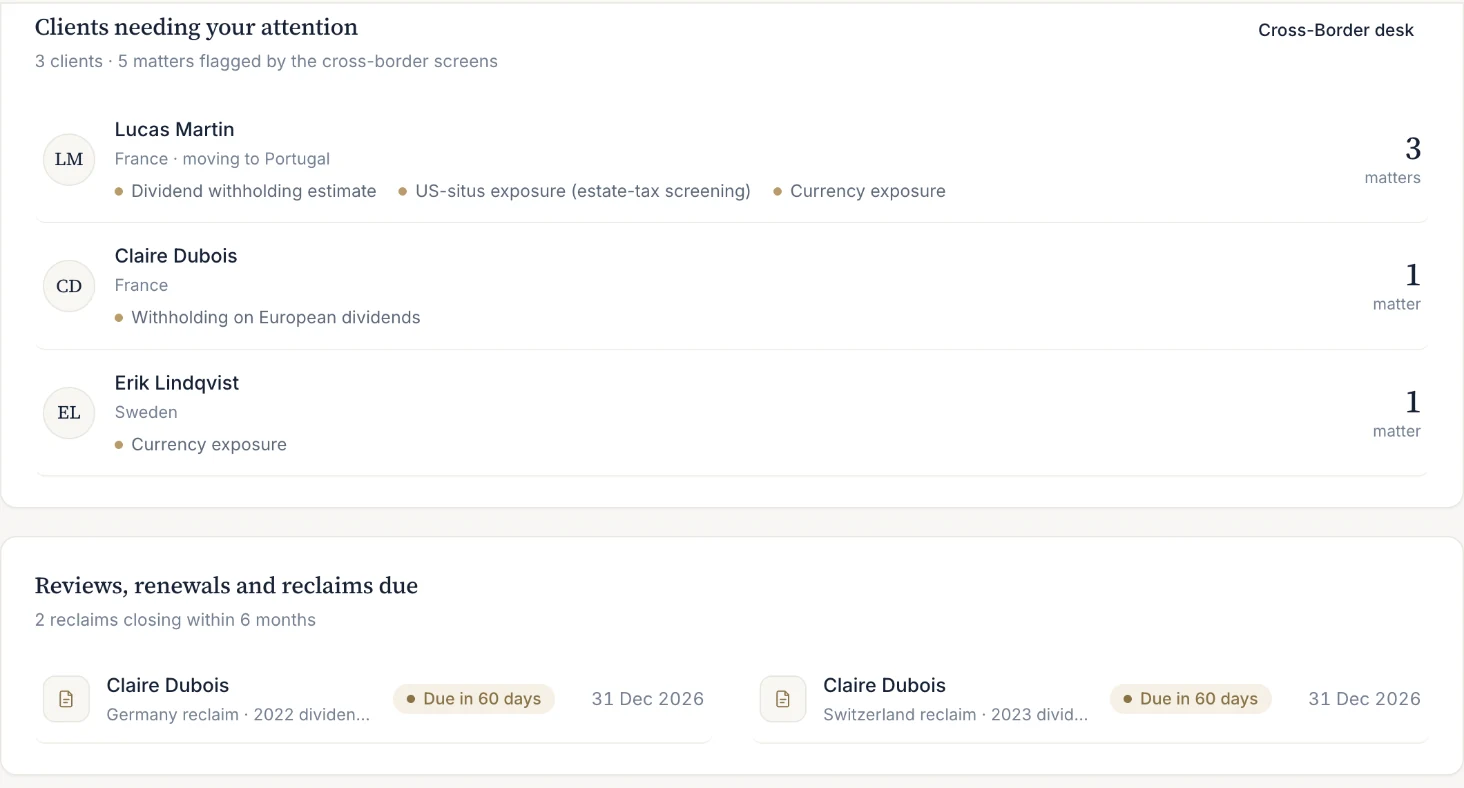
The clients needing attention and the withholding reclaims closing within six months, from every client’s checks on one page.

Try it on a sample firm

Cross-Border desk: every client screened, matters needing attention, the US estate threshold, planned moves, and clients ranked most urgent first
Client dossier: consolidated value in the client's base currency, accounts, expected income and unrealised gain
Holdings of a Swedish client in SEK: value, gain and income, allocation by underlying currency looking through funds, and by fund domicile
Performance across accounts: time- and money-weighted returns, total gain, fees paid and value over time
Cross-border brief: the client's matters ranked, with each figure and its chapter
Withholding on European dividends: withheld, treaty cost and what may be reclaimable, per holding with the route and the last day to claim
Scenario: the cost of switching — taxable gain, capital gains tax, dealing and payback, per holding with sheltered accounts shown apart
Relocation: Canada against the United Kingdom at the client's own rates, and the change in dividends kept on the same holdings
Overview: clients needing attention and the withholding reclaims closing within six months
Screens from the read-only demo workspace: fictional clients, real prices and exchange rates.Two-factor sign-in, organisation isolation and an audit trail are part of the workspace — see Security.

Who it is for

The same path, shaped by the review you are asked for.

Statements in, findings with their sources, a review under your firm’s name: what changes is the question the client brings.

Cross-border advisers

A US citizen in London, a green-card holder in Toronto, an American retiring to Lisbon.

  • Non-US funds screened as likely PFICs, with their share of the portfolio and the Forms 8621 they are likely to bring
  • FBAR and Form 8938 from the year’s highest value of accounts held abroad; brokers with US and non-US entities listed for checking
  • Each holding’s cost and gain in USD and in GBP, CAD or AUD, each under its own country’s rule, every trade at its own date’s rate

Advice-only and DIY portfolio reviewers

A fixed-fee review of an expat’s DIY portfolio at IBKR, Schwab or a local platform.

  • Statements through a secure upload link; IBKR Flex and Schwab history exports read directly, other statements extracted and checked before anything is confirmed
  • An ISA or TFSA flagged as not tax-free in the US; an RRSP, LIRA, LIF or UK SIPP shown as deferred by treaty
  • Fund domicile and look-through currency across every account; fees as money over 1, 5 and 10 years

Investment-led boutique firms

A US person’s existing portfolio, reviewed before any assets move.

  • An objective second opinion: a review can say the portfolio is in order
  • No Irish-fund “saving” for a US person: the non-resident screens are switched off, with the reason in the review
  • For a client in the EU or UK, a proposed US-domiciled fund flagged as possibly unavailable to retail investors (PRIIPs)

Where the client lives adds its own screens: UK reporting fund status for a US citizen in the UK; T1135 and departure tax in Canada, with an IRA, 401(k) or Roth IRA brought there and the treaty election for a Roth. FBAR and Form 8938 thresholds explained.

The sample report

What you put in front of the client.

Each review goes out under your firm's name, with your commentary set apart from Borderfolio's analysis, and never changes after you send it. Every figure states its source and the assumption it rests on; what is not calculated is labelled, not estimated.

  1. Executive portfolio summary1
  2. Portfolio allocation2
  3. Holdings overview3
  4. Performance summary4
  5. Dividends and fees5
  6. Currency and fund-domicile exposure6
  7. Cross-border considerations7
  8. Adviser notes8
  9. Sources, assumptions and limitations9

Illustrative pages; figures are examples.

Pages of a generated report for a fictional US citizen living in the United Kingdom, at real prices, are in the US persons abroad brochure (PDF). Each other country’s site has its own brochure: choose a country.

Security and trust

Your clients’ statements, kept private and under your control.

Advisers upload statements that are not their own, and the workspace is built around that. This describes the product as built, not a certification.

Read the full description
Workspace isolation
Every request is authorised against the adviser’s organisation; an identifier that belongs to another firm reads as not found.
Access controls
Owners manage settings, members and deletions; advisers work with clients, imports and reports. Enforced on the server.
Two-factor authentication
One-time codes with single-use recovery codes. A firm can require it for every member.
Document handling
Files are checked against their declared type. Original statements are purged after seven days; there are no public document links.
Audit history
Imports, confirmations, downloads, reports and membership changes are recorded with the acting adviser.

Plans and pricing

One price per firm, stated in full.

Every plan includes the whole workspace: statement import and review, consolidation, cross-border findings, relocation planning, scenarios and PDF reviews. Plans differ in how many advisers, clients and imports they carry, and in how reports are branded. Firms beyond these limits can ask for a quote.

Founding programme, first 25 firms

Founding Adviser

$99a month

30-day trial without a card. Held for your first 12 monthly payments, or your first year at $999, then the Advisor rate.

Annual billing
$999 a year
Advisers
1
Active clients
50
Extra clients
+25 for $29 a month
Statement imports a month
30
Report branding
Firm name
Shared workspace
Not included

For one adviser

Advisor

$149a month

The full workspace for an independent adviser. Annual billing costs ten monthly payments.

Annual billing
$1,490 a year
Advisers
1
Active clients
50
Extra clients
+25 for $29 a month
Statement imports a month
30
Report branding
Firm name
Shared workspace
Not included

For a small team

Practice

$299a month

Shared clients and branded reports for up to three advisers. Annual billing costs ten monthly payments.

Annual billing
$2,990 a year
Advisers
3
Active clients
150
Extra clients
+25 for $29 a month
Statement imports a month
100
Report branding
Firm name, logo and contact block
Shared workspace
Owner and adviser roles, shared clients

For a firm with its own platform

White Label

$499a month

The workspace on your own domain under your brand, without Borderfolio attribution.

Annual billing
$4,999 a year
Advisers
25
Active clients
500
Extra clients
On request
Statement imports a month
1,000
Report branding
Your brand only, on your own domain
Shared workspace
Owner and adviser roles, shared clients

More clients than your plan carries

Need more clients? Add 25 for $29 a month ($290 a year on annual billing), on the Founding Adviser, Advisor and Practice plans. How packs work.

Start with a plan

Larger firms and specific terms

More than 25 advisers or 500 active clients, more extra clients than the packs above, annual invoicing, or contract and data-processing terms of your own: tell us what your firm needs and we reply personally with a quote within two working days.

Request a quote

The 30-day trial, without a card, comes with the Founding Adviser plan only. Advisor, Practice and White Label start with the first payment: you create the workspace, then pay for the plan in it. Archived clients do not count towards the active-client limit; extra-client packs add 25 places each for $29 a month. Prices are in US dollars and exclude VAT where it applies. Billing is per firm through Freemius, the merchant of record; cancel at any time, and the first payment is refundable within 14 days (billing and refund policy).

Questions advisers to US persons ask

Plain answers.

Who counts as a US person?

A client whose tax residence is the United States, whose citizenship on the profile is US, or whom you flag as a US person, a green-card holder for example. For them the non-resident screens are switched off and the review says why: a W-8BEN does not apply, the USD 60,000 non-resident estate-tax threshold does not apply, and an Irish or other non-US fund would generally be a PFIC rather than a saving. The US-person screens below take their place.

What does the PFIC screen show?

Every fund domiciled outside the US, such as an Irish UCITS ETF, a UK fund or a Canadian ETF, listed as a likely PFIC with its value, together with their share of the portfolio and the number of Forms 8621 that are likely. Domicile is read from the ISIN. Directly held shares are not screened, and a non-US holding that cannot be classified as a share or a fund is listed for checking. No PFIC tax is computed and no Form 8621 is prepared: QEF and mark-to-market elections, the excess-distribution charge and the filing exceptions are for the client’s US tax adviser.

How are FBAR and Form 8938 checked?

From the brokerage accounts on file. An account counts as foreign when its broker’s entity is outside the US; each one’s highest valuation so far this year is added up in USD, at today’s rate, against the USD 10,000 FBAR threshold and the Form 8938 thresholds for a taxpayer living abroad: USD 200,000 at year end or 300,000 at any time if unmarried or filing separately, 400,000 and 600,000 if married filing jointly. Brokers with both US and non-US entities, such as Interactive Brokers or Schwab, are listed for checking against the statement, not counted. Bank accounts and foreign pensions are not on file here and can change the answer.

How is the cost basis worked out twice?

From the confirmed transactions in taxable accounts: once in USD by the US rule, first in, first out, account by account, and once in the residence’s currency by its own rule, the UK’s Section 104 pool, Canada’s average cost or Australia’s parcels, every purchase at its own date’s exchange rate. A holding with a gain in one currency and a loss in the other is flagged: a sale is taxed on different results in the two countries, and a credit for one country’s tax may not match the other’s. It runs today for clients resident in the UK, Canada and Australia. Accounts in tax wrappers are left out, the US wash-sale rule is not applied, and a holding bought before the imported history is named, never guessed.

What about ISAs, TFSAs, pensions and US retirement accounts?

Each account’s wrapper is set on the account. A UK ISA and a Canadian TFSA are flagged as not tax-free in the US: income inside is generally taxable as it arises. An RRSP, LIRA, LIF or UK SIPP is shown as a pension whose US tax a treaty defers until payment; whether a particular SIPP meets the treaty’s definition is not assessed. For a client in Canada, an IRA, 401(k) or Roth IRA is shown with how Canada treats it and, for a Roth, the treaty election and its deadline. US returns are not prepared.

How do the trial and extra-client packs work?

The Founding Adviser plan comes with a 30-day trial and no card: open a workspace yourself, and pay 99 USD a month when the trial ends. That price is open to the first 25 firms and held for their first 12 monthly payments, or for the first year on annual billing at 999 USD. Advisor, Practice and White Label have no trial and start with the first payment. Or tell us about your firm using the form below and we reply personally within two working days to help set it up.

Add active clients in packs of 25 for $29 a month each, on the Founding Adviser, Advisor and Practice plans. Add them from Settings, Plan and usage, once your plan is active: each pack is its own small subscription at exactly $29 a month ($290 a year on annual billing), so a second pack costs the same as the first. Cancel a pack at any time, and cancelling your plan stops its packs too; clients above the new limit stay readable, but no further client can be added or restored until you are within it. Packs stop counting if the subscription lapses. Households do not use extra places: each person is one client, and trusts, SMSFs and joint accounts are accounts of a member.

Review a portfolio together

A more considered way to review client portfolios.

Bring one client or prospect and we will work through the review with you: importing their statements, reading the findings and preparing the report. We set up a small number of firms personally.

Steffan Kharmaaiarvi, founder of Borderfolio

You work with the founder. Steffan Kharmaaiarvi sets up each early firm personally and works through the first client review with you. About · LinkedIn

Prefer to start on your own? Open a workspace with the Founding Adviser 30-day trial, no card needed; plans and prices are listed above.

Clients you advise
We read every request personally.

Bring a clearer perspective to every client portfolio.

Discover a more thoughtful approach to portfolio reviews and international investment analysis.